
Why Job Tracking Is the Most Underrated Job Search Skill
Most job seekers don't have a talent problem. They have a memory problem.
Think about the last time you applied to a batch of roles in one sitting. Ten, maybe twenty applications. A week later, a recruiter replies — and you're staring at the email trying to remember which resume you sent, what the posting actually said, and whether you'd already heard back from anyone else. Multiply that across a month of searching and the whole thing turns into a fog.
That fog is expensive. Not in a dramatic way, but in a slow-leak way: follow-ups slip, promising roles fall through the cracks, and you end up re-reading job descriptions you've already applied to. Job tracking is the unglamorous skill that fixes it — and it's the one almost nobody talks about.
The real cost of not tracking
Applying is the visible part of a job search. The invisible part is everything that happens after you hit submit: waiting, following up, comparing offers, remembering where you are with each company.
When that information lives in your head — or scattered across browser tabs, email threads, and a notes app — a few predictable things go wrong:
- Follow-ups get missed. A polite check-in three or four days after applying is normal and expected. Forgetting to send it isn't fatal, but it's free momentum you left on the table.
- You lose track of what you tailored. If a role asks about a specific skill in a follow-up, you want to know which version of your resume actually went out.
- Momentum stalls. When you can't see how many applications you've sent, it's easy to feel like you're doing a lot when you've actually slowed to a crawl — or the reverse, applying nonstop with no sense of where anything stands.
- Offers get blurry. Comparing two opportunities is much harder when you can't quickly recall which role, which team, and which stage each one is at.
None of this is about discipline. It's about memory load. Tracking is just the practice of moving that load out of your head and into something you can look at.
What good tracking actually looks like
You don't need a spreadsheet with forty columns. You need a small, consistent set of fields that answer the only questions that matter: Where did I apply, when, with what, and what's the next step?
A workable tracker keeps, at minimum:
- The company and role — enough to identify it at a glance.
- The date you applied — your clock for follow-ups.
- Status — a simple pipeline: saved, applied, interview, offer. Four stages is plenty.
- The materials you sent — the resume and cover letter versions tied to that specific role.
- The next action — follow up, prep for a call, send a thank-you. If there's no next action, the entry is dead weight.
The status pipeline is the part people underestimate. Seeing your search as a funnel — many saved, fewer applied, a handful in interview, one or two at offer — reframes rejection. A "no" at the application stage isn't a verdict on you; it's the normal shape of a funnel. Tracking makes that visible instead of emotional.
Tracking and tailoring belong together
Here's where tracking stops being a bookkeeping chore and starts being a job-search advantage. If you track which resume and cover letter you sent to each role, you can start to see patterns: which versions get replies, which phrasing lands interviews, which kinds of roles move forward.
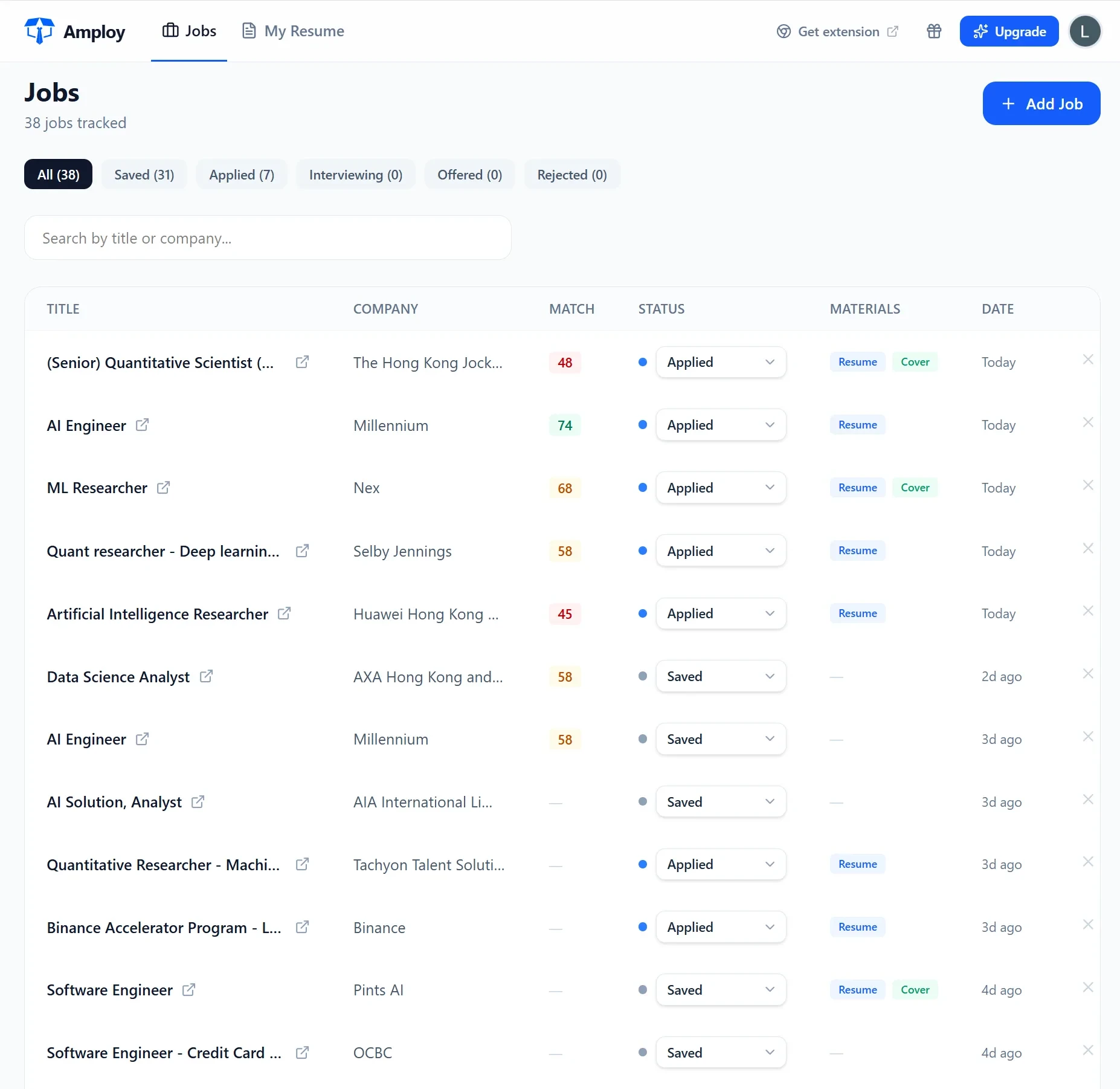
That only works if tailoring is actually happening — and if it's fast enough to keep up with. This is exactly where Amploy fits. Every application you work on in Amploy keeps its tailored resume, generated cover letter draft, and status together, so the tracker isn't a separate spreadsheet you maintain by hand. It's the record of the work you were already doing.
The pipeline sits right next to each tailored resume and letter: Saved → Applied → Interview → Offer. When a recruiter replies, you open the entry and see the exact materials you sent — no digging through email, no guessing which draft went out.
Why volume and tracking aren't opposites
Amploy's whole premise is that volume wins — most roles get hundreds of applicants, and the people who land interviews are the ones applying more, faster. It's tempting to hear that and assume tracking is the opposite of speed, some tidy admin work that slows you down.
It's the reverse. Speed without a record is just noise. If you apply to sixty roles in a month and can't tell anyone where you stand, you haven't actually applied to sixty roles — you've lost track of sixty opportunities. Tracking is what makes volume usable. It's the difference between spraying applications and running a search.
That's why the product is built to remove the busywork on both ends. Autofill handles the repetitive form fields in one click from your profile. Cover letter generation gives you an editable first draft that references the role and your real experience. The resume rewrite matches your actual experience to each job description. And because you'll be hopping between dozens of career sites, the password saver keeps each login on hand — one saved login per career site, not per job.
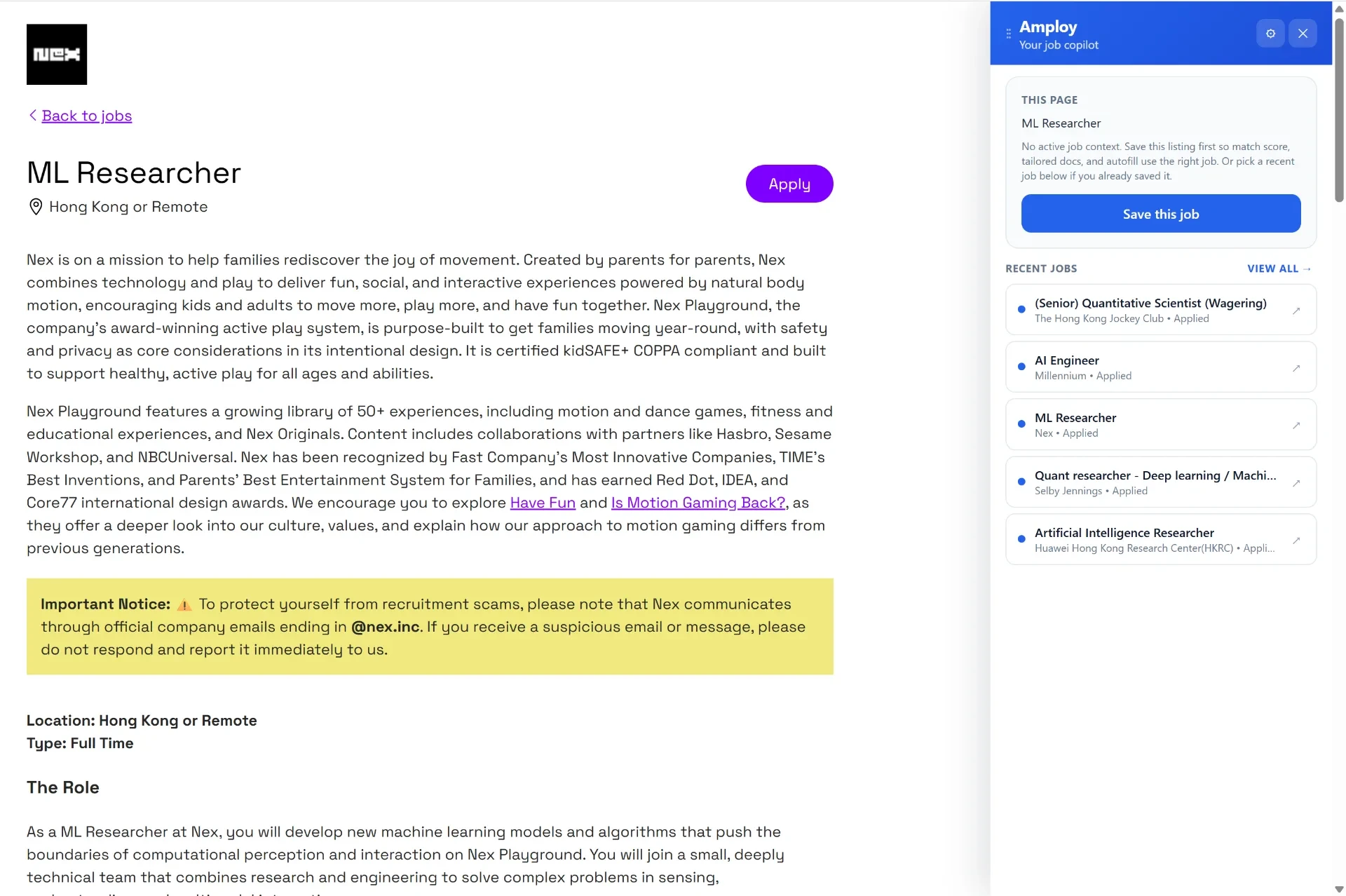
The tracker is what holds it all together. Autofill and tailored documents let you apply faster; the tracker makes sure that speed compounds instead of evaporating.
Start tracking before you think you need to
The best time to start tracking is on application number one, not number forty. The habit is easy when the volume is low and it's the only thing standing between you and a search that feels chaotic.
A simple routine:
- When you save a role, drop it in the tracker as Saved.
- When you submit, move it to Applied and attach the materials you sent.
- When you hear back, update the status and set the next action.
- Once a week, scan the pipeline. Anyone you haven't followed up with? Any role to let go of?
Do that consistently and the fog lifts. You'll know exactly where every opportunity stands, which versions of your materials are working, and what to do next — without holding any of it in your head.
That's the underrated skill. Not applying harder — knowing exactly where you are, so you can keep applying. Amploy is built to make that the default, so you can play the numbers game without burning out.