
Tailored CV vs. Generic CV: What Changes and Why It Works
Most job seekers don't write one CV. They write one CV and send it everywhere — to a fintech, a logistics firm, a startup, a government contractor — and then wonder why the callback rate is so low.
The fix isn't a better generic CV. It's a tailored one. Here's what actually changes when you tailor, why it moves the needle, and how to do it without spending three hours per application.
What "tailored" actually means
A tailored CV is not a rewrite from scratch. It's the same career, reframed for a specific job description. The facts stay fixed: your roles, your education, your projects. What shifts is emphasis and language.
Concretely, tailoring means adjusting:
- The summary — pointing it at the role you're applying to, not the role you have.
- Bullet ordering — leading each role with the work most relevant to this posting.
- Wording — using the job description's vocabulary where it honestly matches your experience (it says "stakeholder management," you say "stakeholder management," not "worked with clients").
- What gets trimmed — the older project that's impressive but irrelevant to this role can shrink or drop.
A generic CV has to be everything to everyone, which usually means it's sharply relevant to no one. Tailoring removes that compromise.
Why it works
Hiring is broken, and volume is the reason. Most roles get hundreds of applicants. Recruiters screen fast, often scanning for the specific signals in the posting. A CV that mirrors the role's requirements is easier to match against the job description — and easier to say yes to.
The uncomfortable part: rejections are rarely personal. The people who land interviews usually aren't better candidates — they apply more, faster, with material that fits each role. That's the numbers game. Tailoring is how you play it without burning out.
The real cost of tailoring (and why most people skip it)
Here's the honest friction. Rewriting a summary, reshuffling bullets, and matching wording by hand takes real time per application. Do that for twenty roles and you've spent days on formatting instead of applying.
That's the trade-off most advice ignores: tailoring is clearly better, but manual tailoring doesn't scale. So people default to the generic CV — not because they think it's better, but because it's the only version that fits their time budget.
Fixing that is the whole point of Amploy.
How Amploy makes tailored CVs the default
Amploy is a job-search productivity tool — a Chrome extension plus website — built around one promise: stop wasting so much time applying to jobs.
For tailoring specifically, it handles the repetitive parts:
- Resume rewrite — Amploy rewrites your real experience to match each job description. Same history, reframed for the role, so the tailored version is your starting point rather than an hour of manual work.
- Cover letter — generates a first draft that references the role and your actual experience, editable for your voice.
- Autofill — one click fills name, phone, work history, and essays from your profile, so the application form itself doesn't eat the time you saved.
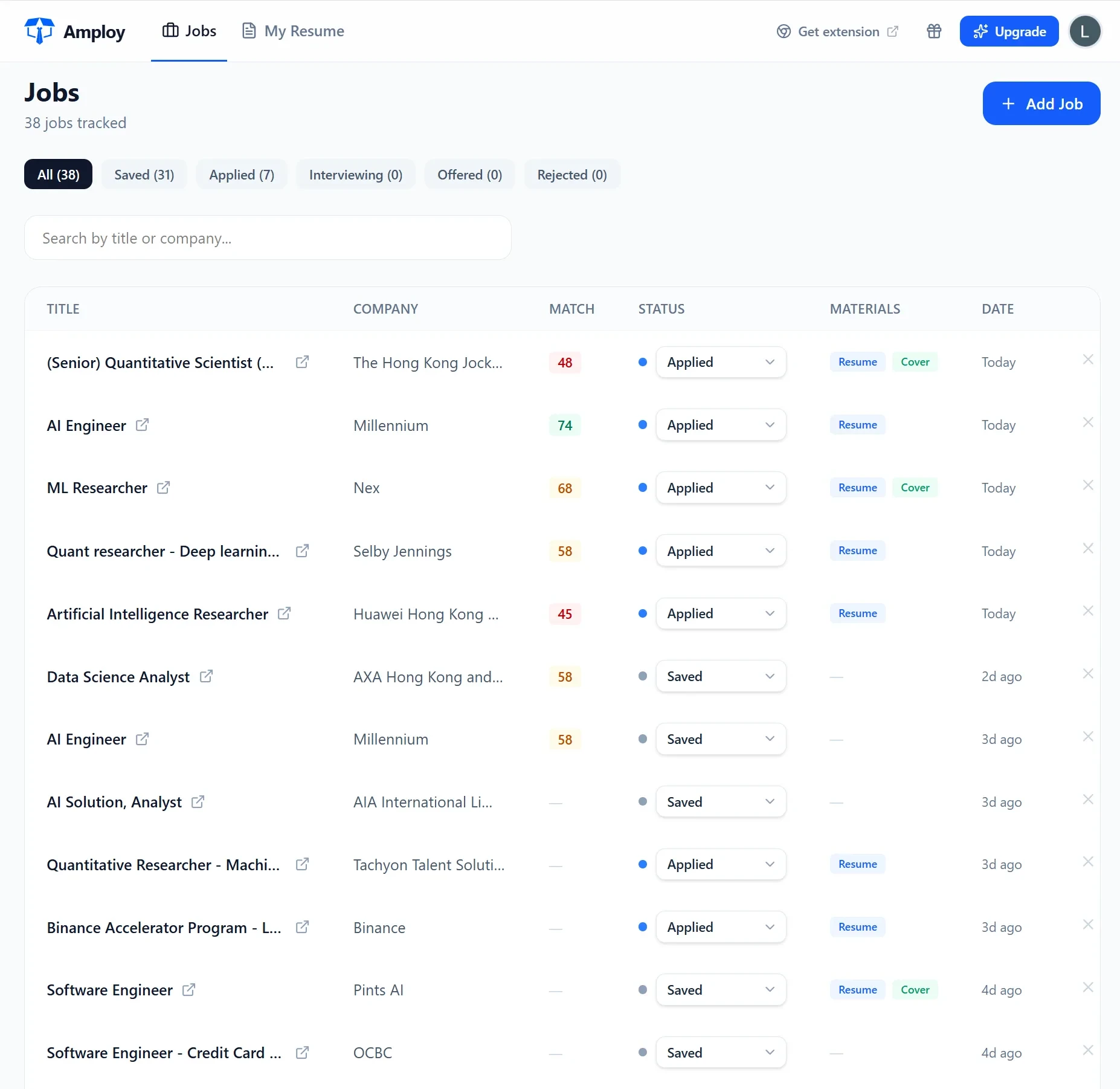
- Job tracker — a status pipeline (Saved → Applied → Interview → Offer) sitting next to each tailored resume and letter, so you always know which version went where.
- Password saver — stores your logins per career site (one saved login per site, not per job), so account creation and sign-in never block an application.
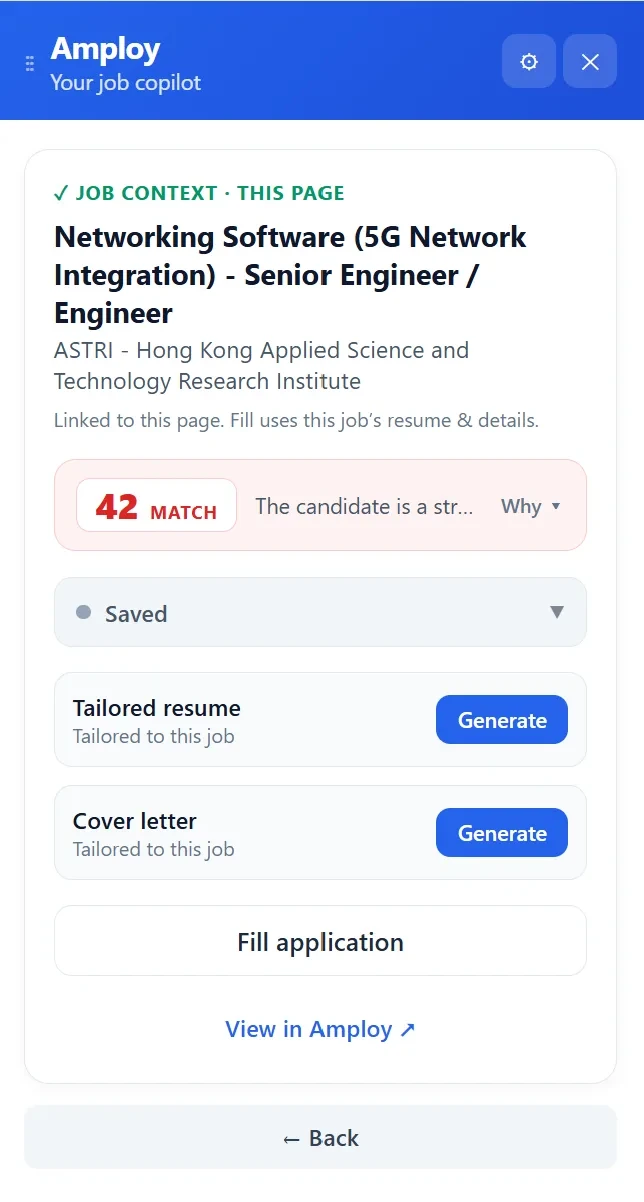
The point isn't that Amploy writes your CV for you. It's that tailoring stops being a decision you have to weigh against applying to one more role. When the tailored version takes minutes instead of an hour, it just becomes what you send.
A practical workflow
If you want to start tailoring today, keep it simple:
- Build one strong base profile. Fill in your real experience once — roles, dates, projects, skills. This is the source of truth every tailored version draws from.
- Read the posting for its vocabulary. Note the three or four phrases the role repeats. Those are the signals to reflect where they honestly apply to you.
- Generate the tailored version, then edit. Use the rewrite as a first draft, and adjust for tone and anything the tool can't know about you.
- Track it. Log the status next to the tailored resume so follow-ups and interviews don't get confused across versions.
- Apply, then move on. Volume only works if you actually keep the pipeline moving.
The bottom line
A generic CV is a compromise you make for speed. A tailored CV removes the compromise — and with the right tooling, it doesn't cost you the speed. That's the entire case for tailoring: the same experience, aimed at the role in front of you, at a pace that lets you apply to enough roles for the numbers to work.
If you're still sending one CV everywhere, that's the habit worth breaking first.