
Tailored CV Checklist: What Recruiters See When You Match the Role
Most rejections don't happen because you weren't good enough. They happen because the person reading your CV had to work too hard to see the fit. Recruiters scan fast — often in seconds — looking for a reason to keep reading or move on. A tailored CV is what gives them that reason.
Here's what actually gets noticed when you match your CV to the role, and how to build one without losing an afternoon to it.
Why tailoring changes what recruiters see
Hiring is broken in a specific way: most roles get hundreds of applicants. Recruiters can't give each CV a careful read, so they skim for signals — does this person's experience line up with what we asked for? A generic CV forces them to connect the dots themselves. A tailored one puts the match right in front of them.
That's the whole game. You're not rewriting your career. You're removing the effort it takes to recognize you.
The tailored CV checklist
Work through these before you hit submit.
1. Mirror the job title and core language
If the posting says "Product Marketing Manager," your CV shouldn't call the same work something else. Use the terms from the job description where they honestly describe your experience. Recruiters scan for those words, and so do the tools that filter applications before a human ever sees them.
2. Lead with a summary written for this role
The top third of your CV does the heaviest lifting. Replace a generic objective with a short professional summary that names the role you're targeting and connects your real experience to it. Two or three lines is enough.
3. Reorder to put the match first
You don't need to change what's true — you need to change what comes first. Pull the most relevant experience, projects, and skills to the top. Buried achievements might as well not be there if the reader never gets that far.
4. Rewrite bullets around outcomes
Each bullet should say what you did and what it produced. Tailoring means choosing which outcomes to emphasize based on what the role values — and trimming the ones that don't serve this application, even if you're proud of them.
5. Align skills with the requirement list
If a skill appears in the posting and you genuinely have it, make sure it's on your CV in the same wording. Missing keywords are one of the most common reasons a strong candidate gets overlooked.
6. Keep the format boring and scannable
Clear headings, consistent dates, no walls of text. Tailoring is wasted if the reader can't move through the page quickly.
7. Cut what doesn't earn its place
Every line competes for attention. If a bullet doesn't support this application, it's taking space from something that does.
The tailoring trap: it's slow, so people skip it
Everyone knows they should tailor. Most don't, because doing it properly for every application means rewriting bullets, reworking the summary, and re-checking keywords — for the tenth time that week. So the tailoring gets thinner, and eventually you're sending the same CV everywhere and wondering why the replies dry up.
That's the trade-off Amploy is built to remove. Instead of starting from a blank page each time, you work from your real profile:
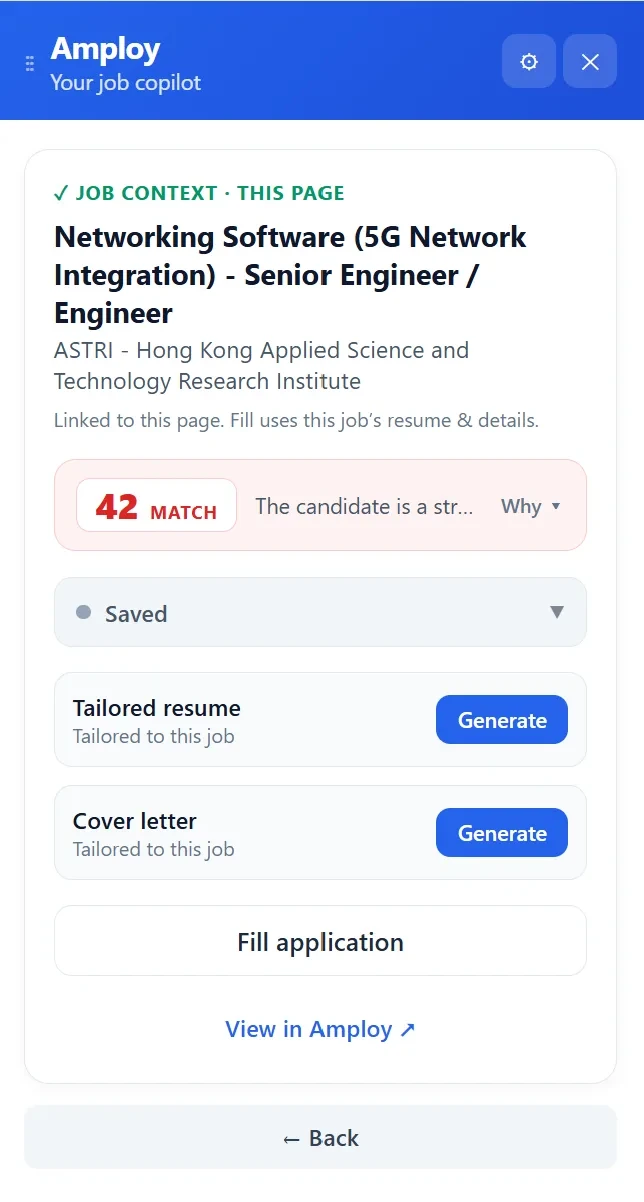
- Resume rewrite takes your actual experience and rewrites it to match the job description, so the mirroring and reordering happen in seconds rather than in a fresh document.
- Autofill fills in your name, phone, work history, and essay questions on application forms in one click, so the repetitive parts don't eat the time you saved.
- Cover letter drafts a first version that references the role and your real experience — then you edit it into your own voice.
- Job tracker keeps your tailored resume and letter next to each application, in a clear pipeline from Saved → Applied → Interview → Offer.

The point isn't to automate your judgment. It's to make doing the right thing — tailoring every application — actually sustainable. Volume wins, but only if each application still reads as a fit.
A quick pre-submit pass
Before you send a tailored CV, ask:
- Could a recruiter find the role's key terms in the top third of the page?
- Does the summary name this job, not a generic one?
- Are the most relevant outcomes first?
- Did you cut anything that doesn't support this application?
- Is it still scannable in under a minute?
If any answer is no, fix it before you apply — that's minutes of work against a much better shot at the interview.
Stop wasting time applying to jobs the hard way. The candidates landing interviews aren't necessarily better than you — they're applying more, faster, with a CV that matches each role. Build that habit, and the numbers start working in your favor.