
Tailor Resume to Job Description Every Time: A Repeatable Workflow
Applying to jobs isn't hard because of the cover letters or the forms. It's hard because you're doing it hundreds of times, and each application asks for a slightly different version of you.
The fix is to stop treating every application as a one-off creative project and start treating it as a repeatable process. Below is a workflow you can run on every role — one that keeps your resume honest but makes it match the job description every single time.
Why tailoring actually matters
Hiring is a numbers game with a hidden filter. Most roles get hundreds of applicants, and recruiters don't read every word — they scan for signals that you're a match for this job. A resume written for "a company" reads as generic; a resume written for this posting reads as a match.
That means the goal isn't to rewrite your whole career for every application. It's to reframe the same real experience so the relevant parts are obvious. Rejections usually aren't personal — the people who land interviews applied more, faster, and more relevantly.
The five-step workflow
1. Extract the job's real requirements
Before you touch your resume, pull five to eight phrases out of the job description: the tools, the outcomes, the responsibilities that are listed more than once. These are the signals the filter is looking for.
Keep this list short. If you try to match every sentence, you'll write a resume that reads like it was written by a keyword generator.
2. Map your real experience to those phrases
For each requirement, find the actual project, role, or result in your history that answers it. You're not inventing anything — you're matching what you've already done to what this role cares about.
If a requirement has no honest match, leave it. One missing keyword costs less than a bullet point you can't defend in an interview.
3. Rewrite the bullets, not the timeline
Your jobs, companies, and dates stay fixed. What changes is the framing of your bullets: lead with the outcome, use the job description's language where it genuinely describes your work, and cut the bullets that don't serve this application.
This is where most people burn an hour per application. It's also where a tool that rewrites your real experience against each job description eliminates the busywork — you review edits instead of writing from a blank page.
4. Draft the cover letter from the tailored resume
Write the cover letter after you've tailored the resume, so it echoes the same points instead of contradicting them. A short first draft that references the role and your real experience gets you most of the way there — then spend five minutes making it sound like you.
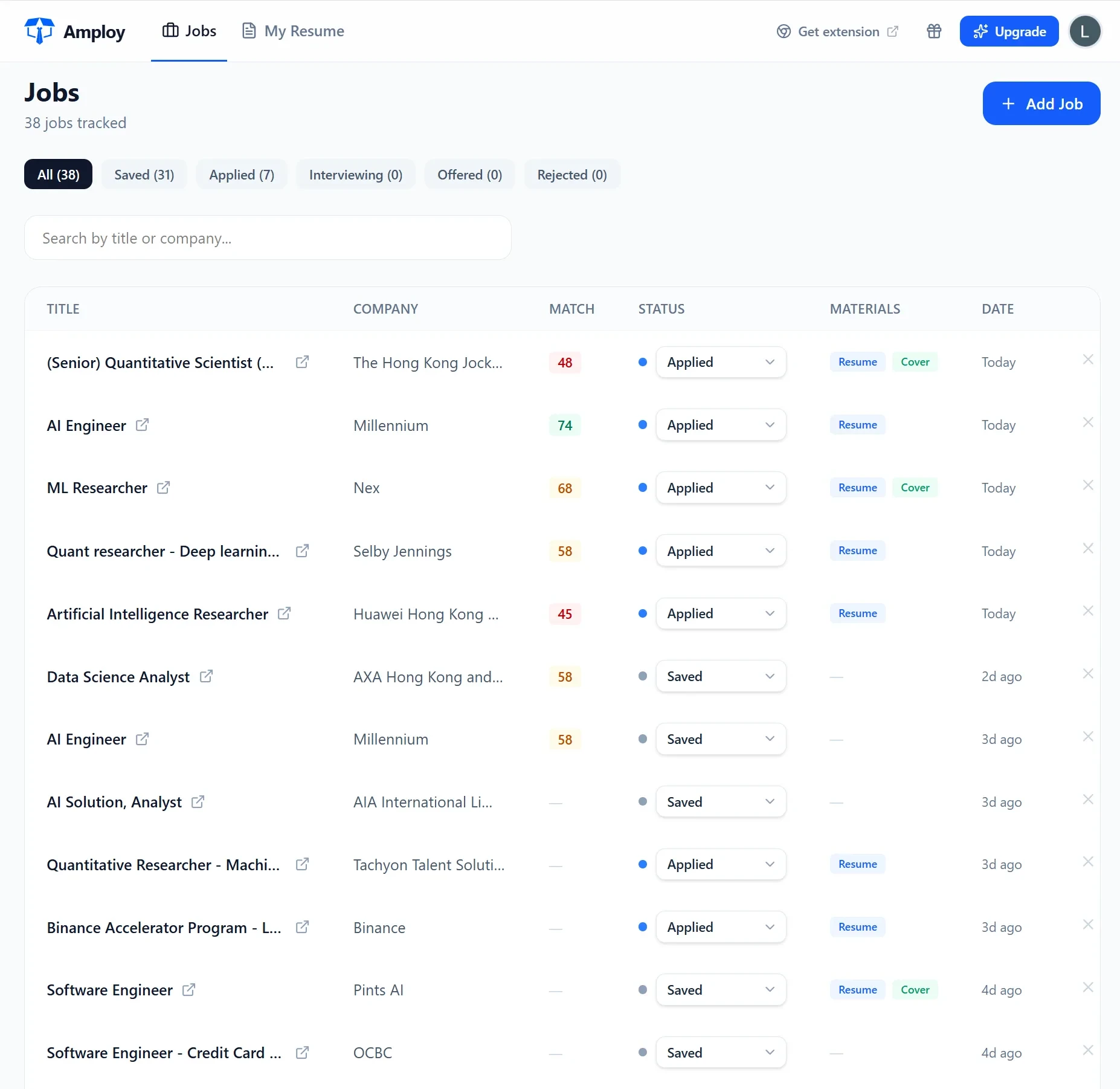
5. Track what you sent
Tailoring only pays off if you can remember which version went where. Whether you hear back or get a rejection, you need to know which resume and letter you sent so you can learn from what's working.
Where this workflow breaks down
Run manually, this process takes 45–90 minutes per application. Do it twice and you'll do it well. Do it fifty times and you'll start skipping the steps that matter — the mapping, the rewrite, the cover letter — and slide back into sending the same generic resume everywhere.
That's the real reason people don't tailor: not laziness, but volume. The workflow is sound; the time cost isn't.
Running it with Amploy
Amploy is built to run this exact workflow faster:
- Resume rewrite takes your real experience and rewrites it to match each job description, so step 3 starts from a draft instead of a blank page.
- Cover letter generates a first draft that references the role and your actual background — editable, so step 4 is a five-minute pass.
- Job tracker keeps each tailored resume and letter attached to its status pipeline (Saved → Applied → Interview → Offer), so you always know what you sent where.
- Autofill handles the form-filling half of applying, so the tailored version is what actually gets submitted instead of forcing a rewrite on the career site.
- Password saver stores one login per career site so a forgotten password never blocks an application you already tailored.
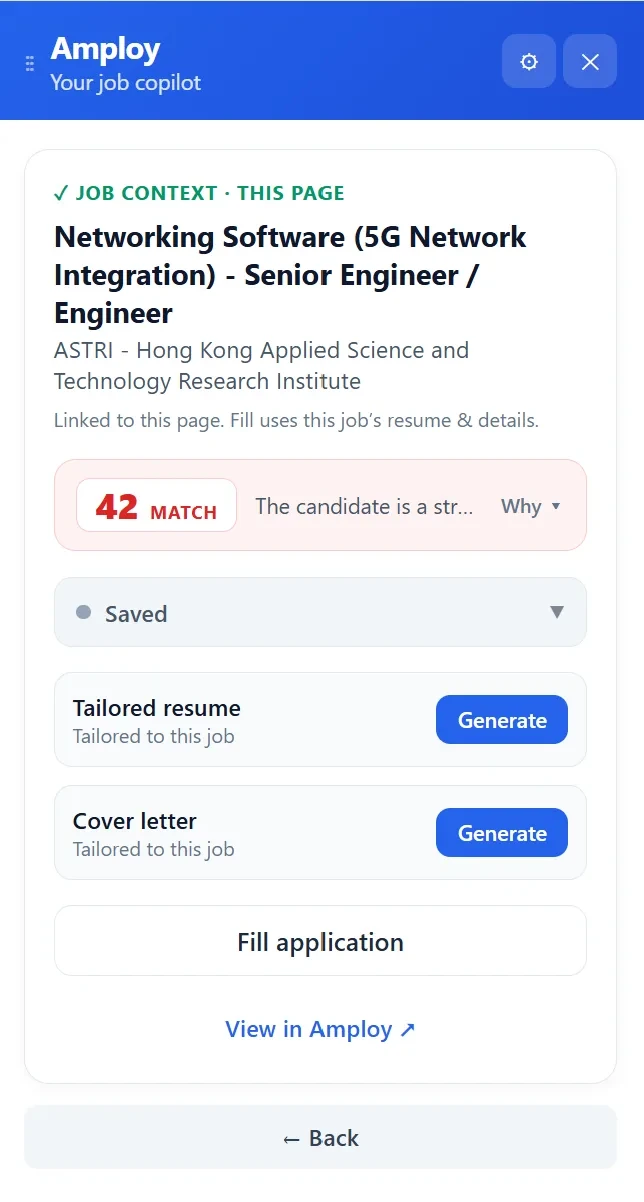
The point isn't that the tool writes your resume for you — it's that it removes the repetitive work that makes you skip the steps that get you interviews. You still review every draft and make it sound like you. You just stop spending an hour doing it.
A quick checklist to keep handy
Before you hit submit, confirm:
- You pulled 5–8 key requirements from the job description
- Every bullet maps to a real project or outcome
- The cover letter references the role and matches the tailored resume
- The application is logged in your tracker with the version you sent
Run those four checks on every role, and tailoring becomes a habit instead of a heroic effort. Play the numbers game — just don't burn out doing it.