
Job Tracking Done Right: A Simple System That Scales With Your Search
Job tracking is the part of the search nobody teaches you
Most job-search advice focuses on the application itself — the resume, the cover letter, the interview. But the thing that actually determines whether a search holds together is what happens after you hit submit. And that's exactly where most candidates lose the plot.
You apply to thirty roles in a week. Then a recruiter emails. Was that the fintech role or the one at the agency? What resume did you send? When did you follow up? The details blur, and the search turns into a pile of open tabs and half-remembered company names.
A job tracker fixes this. Not by making the search more complicated, but by making it visible — so you always know where every application stands, what you sent, and what's next.
Why volume wins (and why tracking is the enabler)
Rejections feel personal, but they usually aren't. When a role pulls in hundreds of applicants, the people who land interviews are rarely the "best" candidate in some abstract sense — they're the ones who applied more, faster, and kept their pipeline full.
That's the core insight behind Amploy: play the numbers game without burning out.
But volume only works if you can keep track of it. Apply to five jobs and you can hold it all in your head. Apply to fifty and you can't. Without a system, volume becomes chaos: missed follow-ups, duplicate applications, interviews you can't prep for because you can't remember which version of your resume got you in the door.
Job tracking is what makes high-volume applying sustainable. It's the difference between a scattershot spray of applications and a managed pipeline.
What "done right" actually means
A good job tracker isn't a spreadsheet you update out of guilt. It needs a few specific qualities:
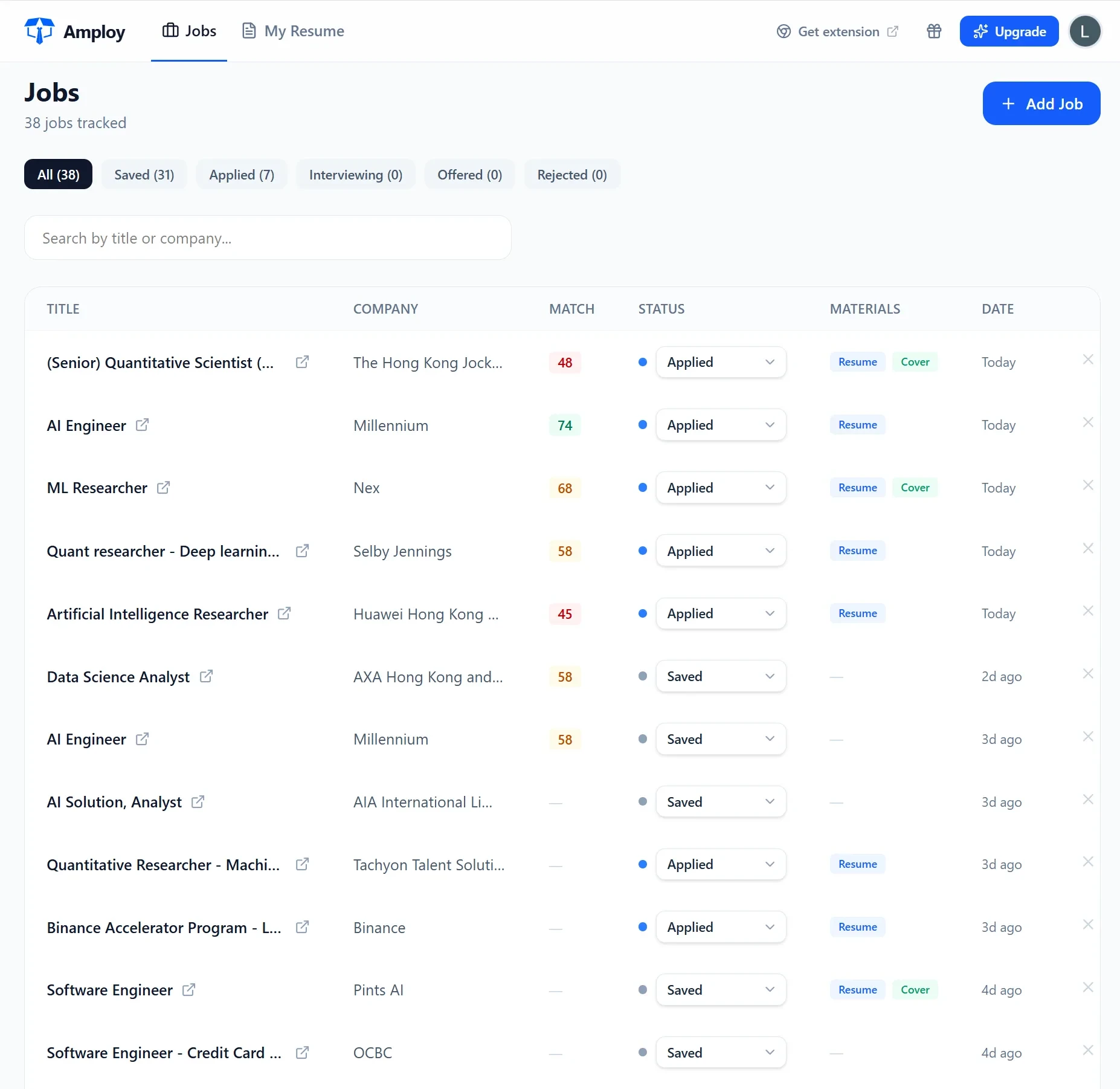
- A clear pipeline. Each application should have a status — saved, applied, interviewing, offer — so you can see the shape of your search at a glance.
- Context next to the status. It's not enough to know you applied to a company. You need to know what you sent: which tailored resume, which cover letter, which version of your story.
- Low friction. If updating the tracker is a chore, you won't do it. The best system is the one that captures information as a byproduct of the work, not as a separate task.
- Scalability. It should feel just as manageable at application #5 as at application #50.
Get these right and the tracker becomes a decision-making tool, not just a record. You can see where you're getting traction, where you're stalled, and where to spend your energy next.
The friction problem with most trackers
Here's the catch: most job-tracking setups fail on the third and fourth points above. A spreadsheet works fine for a dozen applications, but maintaining it means manually copying company names, job titles, dates, and links — every single time. That's exactly the kind of repetitive busywork that makes people stop tracking altogether.
The better approach is to make tracking part of the application flow rather than a separate step. When your tracker lives alongside the tools you use to apply, every application is logged automatically.
How Amploy handles tracking
Amploy is built as a job-search productivity suite for your browser, and its job tracker is designed to scale with your search rather than fight it.
The tracker gives you a status pipeline — Saved → Applied → Interview → Offer — and keeps it right next to each tailored resume and cover letter you've created. That context is the whole point: when a recruiter gets back to you, you can open the exact application, see what you sent, and pick up the conversation without scrambling to reconstruct it.
Because Amploy also handles the parts of applying that usually happen in separate tools, tracking becomes a natural side effect of the work:
- Autofill fills in name, phone, work history, and essays from your profile in one click.
- Resume rewrite adapts your real experience to match each job description.
- Cover letter generates a first draft referencing the role and your experience — editable for your voice.
- Password saver stores your logins for each career site, so you're not resetting a password every time you return to check a status.

That last one sounds minor, but it matters more than people expect. When you're applying at volume across dozens of company portals, forgotten passwords are a real source of friction — and friction is what stops you from keeping your tracker current.
A simple rhythm that scales
The system itself is deliberately lightweight. It's not another job to manage; it's a rhythm:
- Save roles you're curious about as you browse, so nothing slips away.
- Apply — with tailored materials and autofilled forms — and let each application move to Applied automatically, with its resume and letter attached.
- Check your pipeline regularly. Notice where things are moving and where they're quiet.
- Follow up and prep using the context that's already there: the role, the version of your resume, the cover letter you sent.
The beauty of this rhythm is that it doesn't get harder as your search grows. Ten applications or a hundred, each one has a status and a set of documents attached. You're never reconstructing your search from memory.
Stop tracking in your head
If your job search currently lives in your head, your inbox, and twelve open tabs, you're carrying cognitive load that should be handled by a tool. That load is exactly what slows you down when you're trying to apply more, faster.
Amploy's tracker, autofill, resume rewrite, and cover letter generation are all built to work together in your browser — so tracking becomes the natural record of a search you're already running, not a separate chore. Add the extension, apply to your next role, and watch your pipeline start to build itself.
The numbers game only works if you can see the board. Job tracking done right is how you keep it in view.