
Job Search Burnout Is Real — Here's a Lighter Way to Run Your Search
Job search burnout is real, and it rarely announces itself. It creeps in quietly: the tab you keep open "just in case," the application you started three times, the cover letter you rewrote until it stopped sounding like you. The tasks themselves are small. Done in volume, they add up to something heavier.
Here's what most career advice gets wrong about job search stress. It treats burnout as a mindset problem — take a break, stay positive, visualize the offer. But the main cause is usually structural. If you're applying the way most people apply, your search is full of repetitive work that drains your attention without moving your outcome.
Why the job search is so exhausting
Think about what one meaningful application actually requires. You read the job description carefully, compare it to your resume, revise your bullet points to match the language, write a cover letter that references the role and your real experience, then retype your name, phone, work history, and links into yet another form. Repeat that across dozens of applications and burnout isn't a failure of willpower. It's just a volume problem.
And the volume works against you either way. Most roles get a flood of applicants, so the people who land interviews tend to be the ones who apply more, and faster. When every application costs you an hour of tailoring and data entry, you can't compete on volume without burning out.
That's the trap: you know the numbers matter, but the process makes the numbers impossible to hit.
Cut the busywork, not the effort
The obvious fix is to apply less carefully — spray-and-pray. But a generic resume gets tuned out, and sending junk applications doesn't feel good either.
The better path is to make the careful version cheaper. A lot of the job search isn't judgment or tailoring. It's copying, pasting, and retyping the same information. That's exactly the part worth automating, and it's what Amploy is built for.
Instead of starting each application from a blank form, you work from a saved profile:
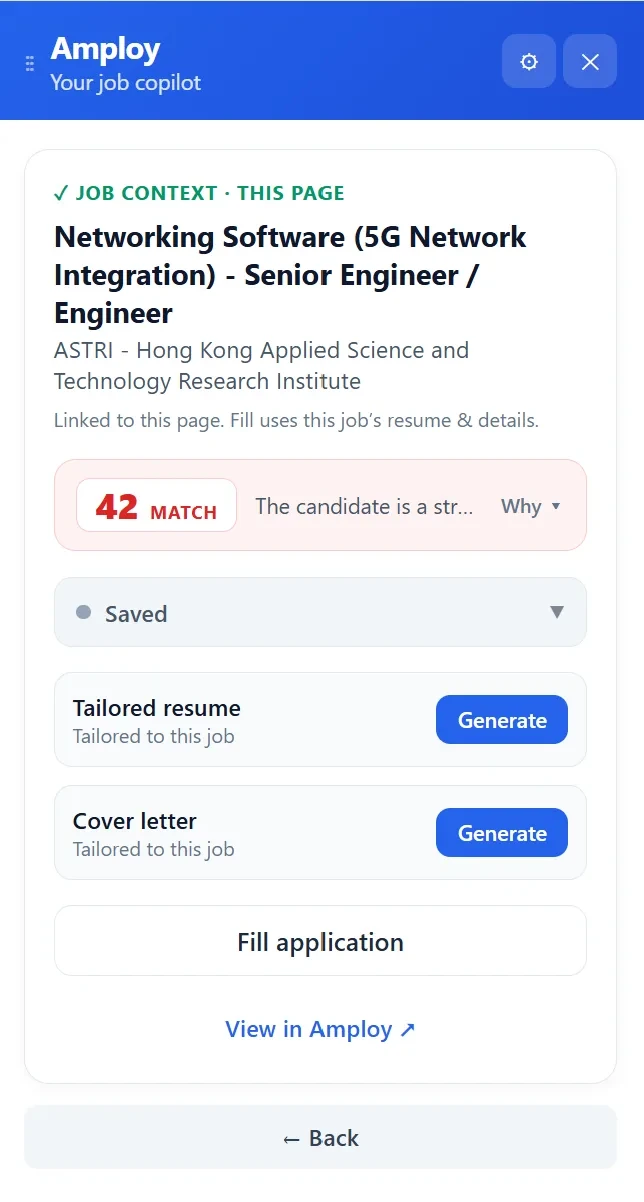
- Autofill — your name, phone, work history, and essays fill in with one click, so the form isn't a fresh obstacle every time.
- Resume rewrite — the tool rewrites your real experience to match the specific job description, so each application reflects the role in front of you.
- Cover letter — a first draft is generated referencing the role and your actual experience, ready for you to edit into your own voice.
The important part: tailoring stays, but the typing and retyping that drains you goes. You're still making choices about what to highlight. You're just not starting from zero with every role.
Stop the chaos of scattered tabs
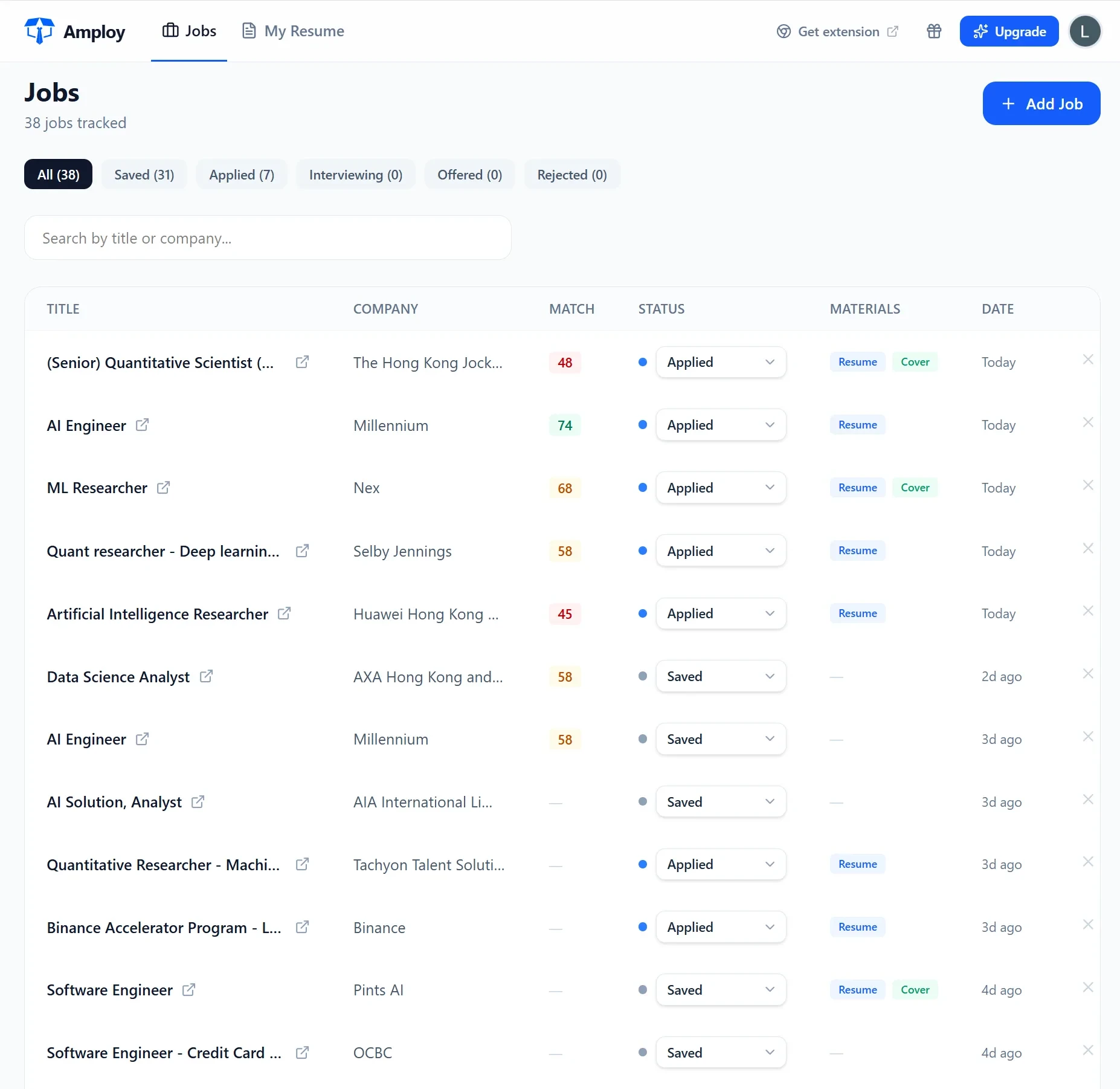
A surprising amount of job search stress isn't the work itself — it's the tracking. Which version of your resume went to which company? Did you already apply here? Did they ask for a follow-up?
When your applications live in a dozen browser tabs and a notes app, remembering where things stand is its own job. That low-level "did I forget something?" hum is exhausting.
A tracker turns it into a simple pipeline — Saved → Applied → Interview → Offer — with each tailored resume and letter sitting next to the application it belongs to. You can see at a glance what you've sent and who's overdue for a nudge, instead of reconstructing it from memory.
The small friction you didn't count
You'd be surprised how often momentum dies at a login screen. You signed up for a company's career portal weeks ago, and now you can't remember the password. You try three variations, request a reset email, and by the time you're back in, the energy to finish the application is gone.
It sounds trivial, but those little interruptions are exactly what drains a search. A password saver for your career-site logins (one saved login per site) turns a five-minute detour into a click — and keeps you in flow across dozens of portals.

What a lighter search actually looks like
Here's the shift. You stop measuring your search by hours spent and start measuring it by applications that actually reflect your experience. You spend your energy on the judgment calls — which roles are worth your time, what to emphasize — and let the tooling carry the repetitive load.
A lightweight routine:
- Be selective up front. Narrow to roles that fit your background. The point of speed isn't to apply everywhere — it's to apply everywhere that matters.
- Tailor in minutes, not hours. Use the resume rewrite and cover letter draft as a starting point, then add your own voice where it counts.
- Apply the same day. Autofill means the form doesn't cost you another session.
- Track as you go. Move each role through the pipeline so nothing slips and you're never guessing.
- Check in, not up. A glance at the tracker shows you what's moving without living in your inbox.
Set a sustainable rhythm. Burnout comes from the grind, not from a lack of determination. Make the grind smaller and you actually get to stay in the hunt long enough for the numbers to work.
Getting started
Amploy is a Chrome extension plus a website, so it sits right where you already apply. Install it, set up your profile once, and let autofill, tailoring, letters, tracking, and saved logins handle the repetitive parts.
You don't have to choose between applying carefully and applying enough. When the busywork is off your plate, you can do both — without burning out.