
How to Write a Tailored CV for Every Role Without Starting From Zero
Applying for jobs has quietly become a full-time job of its own. Every posting wants a slightly different version of your CV — new keywords, reordered experience, a fresh summary — and building each one from scratch is the fastest route to burnout. The good news: tailoring doesn't have to mean rewriting. Once you set up a strong master CV and a repeatable process, each tailored version becomes a short, targeted edit rather than a blank page.
Here's how to do it without starting from zero every time.
Start with a master CV, not a fresh document
The mistake most people make is treating each application as a brand-new document. Instead, think of your CV as two layers:
- The master CV — everything you've ever done: every role, project, skill, and achievement, written out fully.
- The tailored CV — a subset of the master, reordered and reworded to match one specific job description.
Your master CV is your source of truth. You never apply with it directly, but you pull from it every time. This single habit is what allows you to tailor quickly, because you're never inventing content — you're selecting it.
Read the job description like a checklist
Before you touch your CV, read the posting with a pen in hand. Highlight:
- The exact job title and how it's phrased (mirror their language).
- Must-have skills and tools — these are your priority keywords.
- Repeated phrases — if they mention "stakeholder management" three times, that's a signal.
- The top three to five responsibilities — these tell you which of your experiences to lead with.
You're not keyword-stuffing. You're translating your real experience into the language the employer already uses. If they say "data pipelines" and you say "ETL processes," you're probably describing the same thing — use their term.
Reorder, don't rewrite
Most of the tailoring work is rearrangement, not writing. For each new role:
- Move your most relevant experience to the top of each section.
- Reorder bullet points so the ones that map to the job description come first.
- Trim what isn't relevant — a long-ago role or an unrelated side project can shrink to one line or go entirely.
Because you're working from a master document, this is a fifteen-minute exercise, not an afternoon. The words already exist; you're just choosing the sequence.
Rewrite the summary for each role
Your professional summary is the one section worth actually writing fresh each time — it's three or four lines, and it's the first thing a recruiter reads. A strong tailored summary does three things:
- Names the role you're targeting.
- Connects your most relevant experience directly to it.
- Signals the outcome you deliver.
Keep it concrete and specific to that posting. It should read as if it was written for this job, because it was.
Tailor the experience bullets, not the facts
This is where people overcorrect. When tailoring bullet points, change the framing and emphasis, never the underlying facts. Reframe the same achievement so its relevance to the new role is clearer:
- Lead with the result, then the method.
- Swap in the employer's vocabulary where it's an honest synonym.
- Cut bullets that don't speak to this role and expand the ones that do.
Your experience stays true. Only the spotlight moves.
Keep your tools close
Tailoring is only worth doing if you're also applying to enough roles for it to matter — and that's where the repetition really bites. Rebuilding summaries, rewording bullets, and re-entering the same details into endless application forms is exactly the busywork that eats your week.
This is where Amploy fits into the process. Working from your real experience, it rewrites your CV to match each job description, so your master CV becomes a tailored draft in one step — and you can edit it for your own voice rather than starting from nothing.

Cover letters work the same way: Amploy generates a first draft that references the specific role and your actual experience, which you then shape into something that sounds like you. And because hiring is a numbers game — most roles draw hundreds of applicants, and the people who land interviews simply apply more, faster — removing the per-application grind is what lets you tailor and apply at volume without burning out.
Save your logins so you never lose momentum
One overlooked part of applying at volume: the application systems. Different career sites, different portals, different accounts — and the password you set six months ago that you can't remember. Getting locked out of an application you were halfway through is a quiet but real time sink.
Amploy's password saver keeps one saved login per career site, so you're never resetting a password instead of finishing an application.

Track which version went where
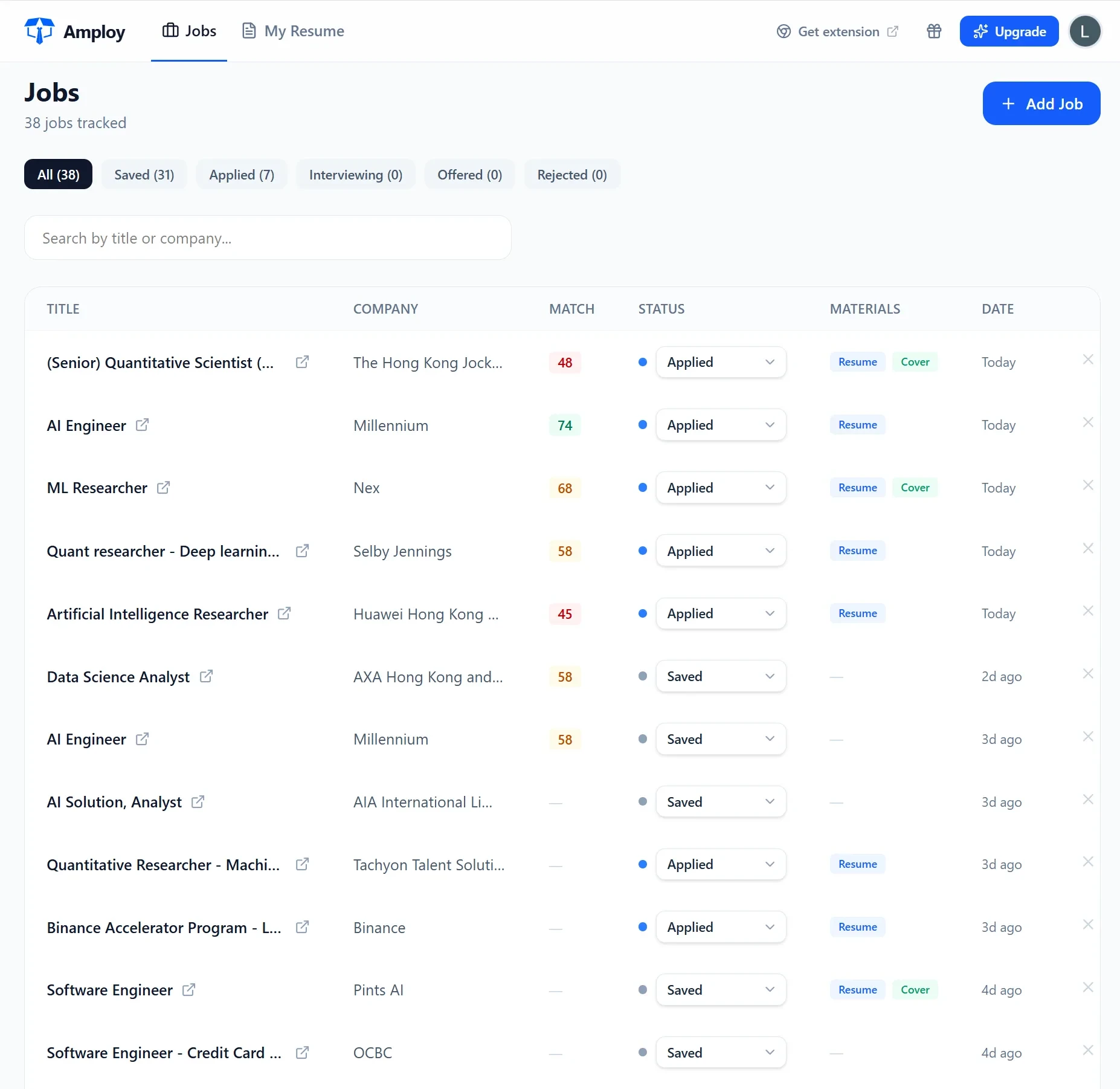
When you're sending tailored CVs to many roles, it's easy to lose track of what you sent and where. Keep each tailored CV and cover letter attached to its job in a tracker, with a simple status pipeline: Saved → Applied → Interview → Offer.
That record does two useful things. It tells you which tailoring approach is getting responses, so you can double down on what works. And it stops you from re-applying to a role you've already pitched — or from missing a follow-up you meant to send.
A repeatable five-step loop
Put it all together and tailoring becomes a routine rather than a chore:
- Open your master CV — the source of everything you'll use.
- Highlight the job posting — title, must-haves, repeated phrases, top responsibilities.
- Reorder and trim — pull the most relevant experience to the front and cut the rest.
- Rewrite the summary and reframe the bullets that matter most.
- Log it in your tracker with the tailored CV and letter attached.
Each pass gets faster. Your master CV does the heavy lifting; each tailored version is a short, focused edit on top of it.
Stop starting from zero
The reason tailored CVs feel exhausting is that most people build them the hard way — from a blank document, every single time. Change the starting point and the whole process shrinks. Set up a master CV, decide what to reorder and emphasise for each role, and let a tool handle the rewrite and the repetitive form-filling.
That's the whole idea behind Amploy: stop wasting so much time applying, and spend it on the applications that actually move you forward.