
How Often Should You Tailor Resume? A Rule of Thumb
You know the advice: tailor your resume for every job. You also know what it costs — twenty minutes here, forty minutes there, an evening gone, and a pile of applications that still feels too small.
So how often should you actually tailor? The honest answer is "every time it matters," but that's useless as a rule of thumb. Here's one you can act on.
The short version
Tailor every application you genuinely want — and use a fast pass, not a rewrite, for the rest.
In practice, that breaks down into three tiers:
- Top-priority roles (your realistic dream list): full tailoring. Rewrite the summary and the most relevant bullets, adjust keywords, write a real cover letter.
- Solid-fit roles (you'd take the interview): targeted tailoring. Rewrite your resume headline and 3–5 bullets to mirror the job description, and send a short tailored cover letter.
- Speculative or stretch applications: light tailoring only. Match the job title and top keywords, then move on.
Most job seekers get this backwards. They spend 90 minutes on one dream application and then fire off twenty untailored ones — or they tailor everything so heavily that they apply to three jobs a week. Both lose. Volume matters, but volume of relevant applications.
Why tailoring still matters at all
Hiring is broken in a specific way: most roles get hundreds of applicants, and a recruiter skimming resumes is looking for a reason to say no. An untailored resume gives them one in the first five seconds — the summary talks about the wrong thing, the bullets don't mention the skill in the job title, the cover letter says "I am writing to express my interest."
Tailoring doesn't make you a better candidate. It makes you a legible one. Rejections are rarely personal; they're usually a mismatch between what the posting asked for and what the skim found.
That's also why "tailor everything perfectly" is bad advice. The bottleneck isn't your willingness — it's the time cost per application.
A rule of thumb you can actually schedule
Try this: tailor to the depth the role deserves, and cap the time.
| Role type | Time budget | What you change | |---|---|---| | Dream / top priority | 30–45 min | Summary, key bullets, cover letter, keywords | | Good fit | 10–15 min | Headline, 3–5 bullets, short letter | | Speculative | 2–5 min | Title match and top keywords |
The cap is the important part. If you're spending an hour on a job you're lukewarm about, you're not being thorough — you're procrastinating with extra steps.
A second rule: if you can't name the three things the posting cares most about, you haven't read it closely enough to tailor. That's your checklist. Everything else is optional.
Make tailoring the default, not the project
The reason most people don't tailor consistently isn't discipline. It's friction. Opening your master resume, copying it, hunting for the right bullets, rewriting the same summary for the tenth time — that's the busywork that eats the hour.
This is exactly the gap Amploy is built for. Load your real experience once, then for each job:
- Resume rewrite reshapes your actual experience to match the job description, so you're editing a relevant draft instead of starting from a blank page.
- Cover letter generates a first draft that references the specific role and your real background — you adjust the voice, not the substance.
- Autofill handles the application form itself, so the tailoring isn't undone by twenty minutes of retyping your work history.
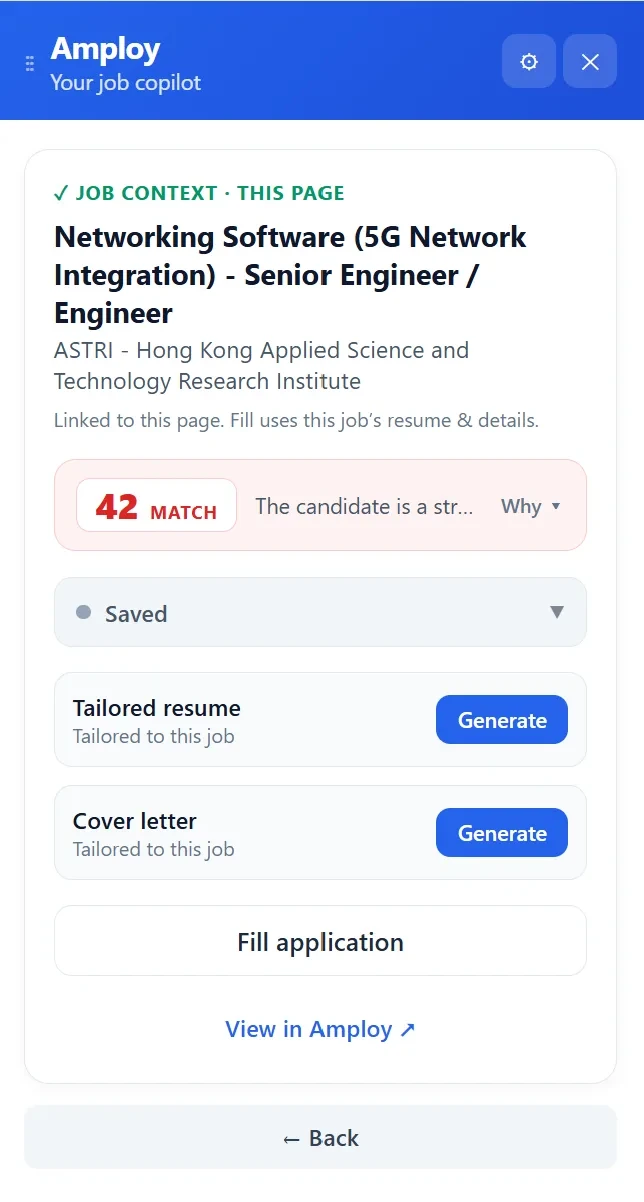
The point isn't to remove your judgment. It's to move the 45-minute tailoring job down to a few minutes, which changes the math: you can now afford to tailor the "good fit" tier properly instead of skipping it.
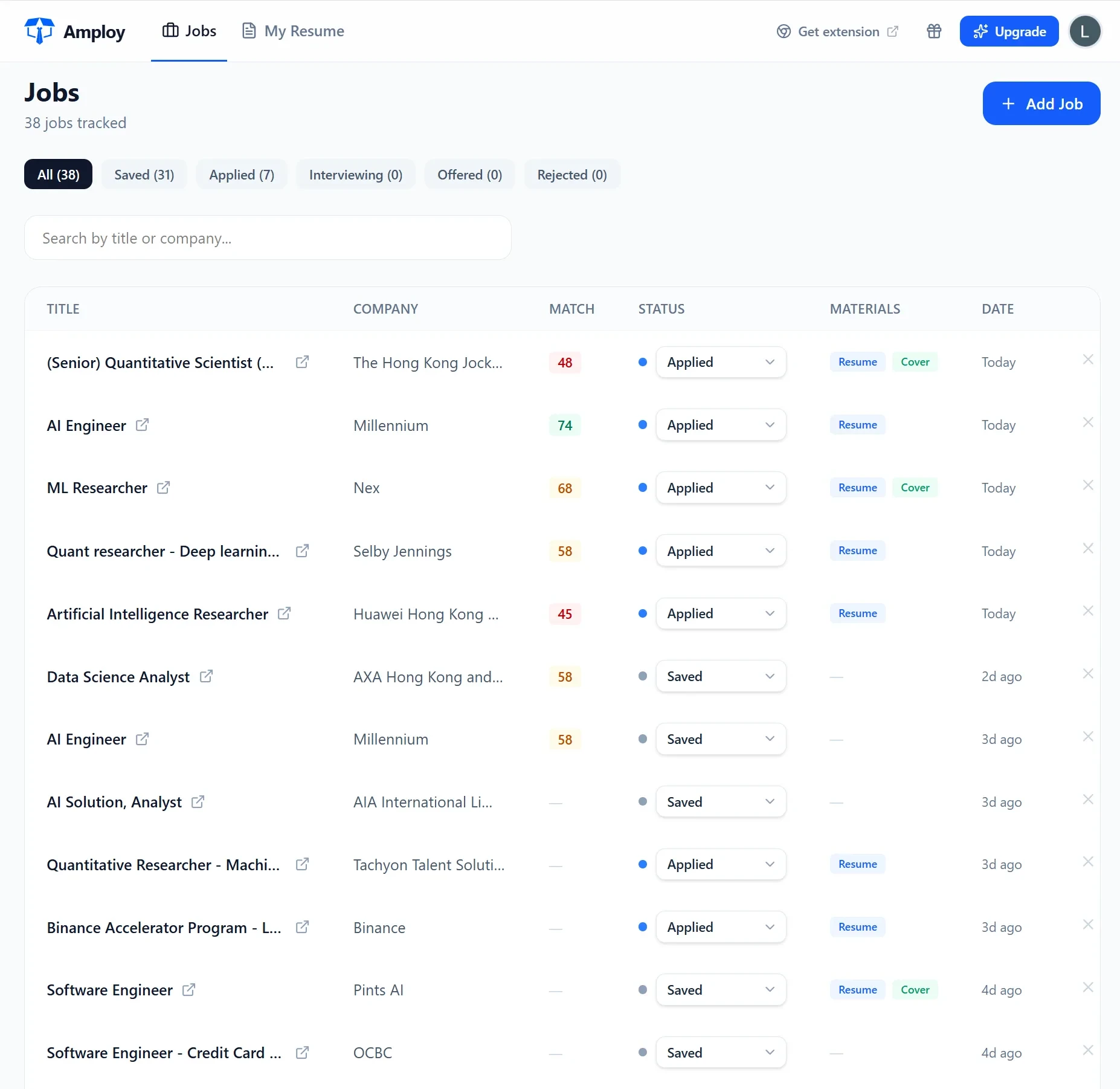
And because tailoring only works if you can keep track of what you sent where, the job tracker keeps each tailored resume and letter attached to its role, moving through Saved → Applied → Interview → Offer. No more guessing which version went to which company.
When not to tailor
Tailoring has diminishing returns in a few cases:
- Job boards with one-click apply where the posting is a generic repost — match the title and keywords, don't rebuild your resume.
- Referrals where a human is already advocating for you — a strong general resume plus a tailored note to your referrer beats a rewritten document.
- Roles clearly outside your level — tailoring won't fix a seniority mismatch. Apply, but don't invest.
The rule of thumb isn't "always tailor." It's "spend tailoring effort where the role justifies it, and never let the effort stop you from applying."
The bottom line
Tailor every application you care about, at a depth that matches how much you care, with a hard time cap. Then apply to more roles than feels comfortable — because the people landing interviews aren't necessarily better than you; they're applying more, faster, with resumes that actually match.
If the tailoring itself is what's slowing you down, that's the part Amploy exists to remove. Set up your profile once, and let each application start from a relevant draft instead of a blank page.