
How a Job Tracking App Keeps Your Tailored Resumes and Applications in Sync
Applying to jobs at volume creates a new problem: keeping track of what you sent where. You tailor a resume for one role, write a cover letter for another, and a week later you can't remember which version went to which company. A job tracking app solves that by keeping your tailored resumes, cover letters, and application statuses in one connected place — so nothing gets lost between the moment you hit submit and the moment you follow up.
Why tailored applications get out of sync
Tailoring is the right move. Rewriting your experience to match each job description and drafting a cover letter that references the specific role gives you a real edge over generic submissions. But tailoring multiplies your documents. Five applications becomes five resume versions and five cover letters — each one slightly different, each one tied to a different company and a different stage of the process.
Without a system, three things tend to happen:
- Version confusion. You open your resume folder and see six files with similar names. You're not sure which one was tailored for the role you're now interviewing for.
- Follow-up blind spots. You lose track of which applications are still waiting, which have moved to interview, and which you should nudge.
- Repeated work. You re-tailor a resume for a company you already applied to, because you didn't realize the earlier version existed.
None of this is a discipline problem. It's a structure problem — and it compounds as you apply to more roles.
What a job tracker actually does
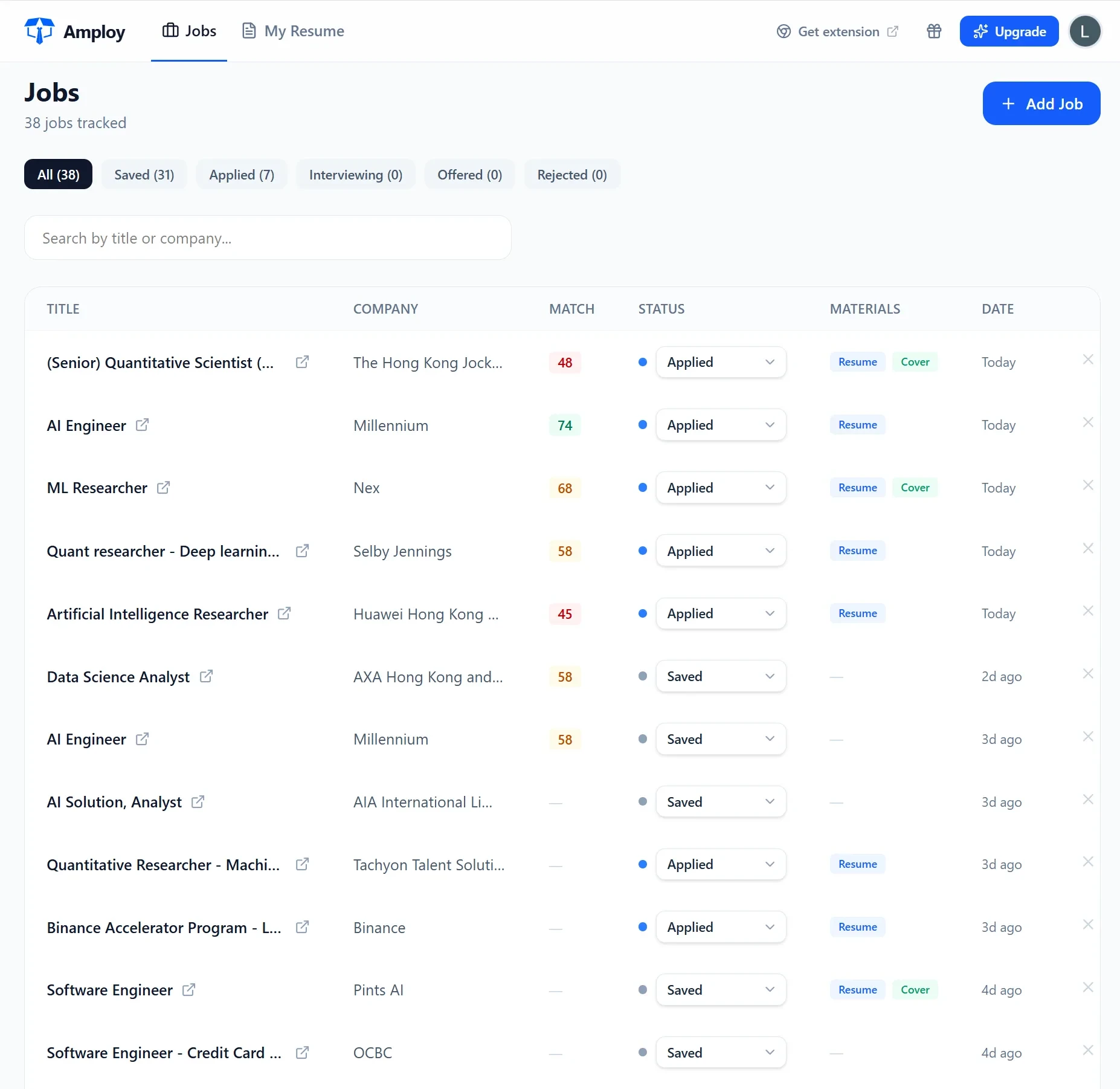
A job tracking app replaces scattered files and mental notes with a single pipeline. In Amploy, every application sits in a status flow — Saved → Applied → Interview → Offer — and your tailored resume and cover letter live right next to it.
That changes how you work:
- You see the whole pipeline at a glance. Instead of guessing where each application stands, the board shows you. You know what needs a follow-up and what needs preparation for an interview.
- Every document stays linked. The resume rewrite and cover letter draft you generated for a specific role are stored with that role — not floating in a downloads folder.
- You stop duplicating effort. Before tailoring for a company, you can check whether you've already applied — and reuse what you have.
How Amploy keeps resumes and applications in sync
Tracking works best when it's built into the same tool that creates your documents. In Amploy, the workflow is continuous rather than a set of separate steps:
- Tailor — the resume rewrite matches your real experience to the job description, and the cover letter generator drafts a first version referencing the role. Both stay editable so the voice is yours.
- Apply — autofill completes the application form from your profile in one click.
- Track — the tailored resume and letter are saved alongside that application in the job tracker, in its current status stage.
Because the tailoring, applying, and tracking all happen in the same extension and website, there's no gap where documents and statuses drift apart.
A quick example
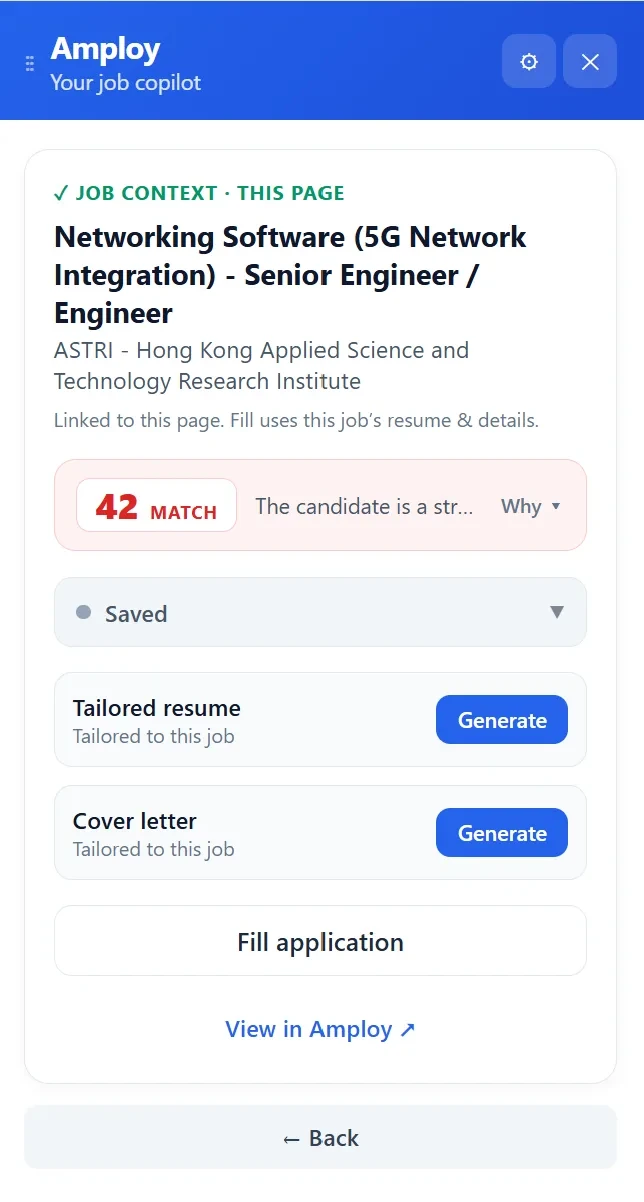
Say you're applying to a Senior Engineer role. The extension reads the job context and shows you what it can generate: a tailored resume, a cover letter, or a direct fill of the application. You generate the documents, fill the form, and submit. The application lands in your tracker as Applied — with that role's resume and cover letter attached.
Two weeks later, when you're reviewing your pipeline, you can see exactly which documents went with that application before replying to the recruiter or preparing for an interview. No digging, no guessing.
Why this matters if you're playing the numbers game
Applying to more roles is a sound strategy — most openings attract hundreds of applicants, and rejections usually aren't personal. But volume only works if you can keep it organized. The people who land interviews apply more, faster and keep their applications straight. A job tracker is what makes the speed sustainable instead of chaotic.
Amploy is built around that idea: automate the repetitive parts, keep tailored documents tied to the applications they belong to, and let the tracker hold the thread so you don't have to. If you're ready to stop losing track of what you sent where, get started with Amploy and let your applications, resumes, and statuses stay in sync from the first apply to the offer.