
Cover Letter Format: a Simple Template That Works in 2026
Most cover letters don't fail because the writer is bad. They fail because the format is a mess — no clear opening, a wall of text in the middle, and a closing that just trails off. A good format won't write the letter for you, but it gets the structure out of the way so the substance can land.
Here's a simple, reliable format you can reuse for every role.
The format at a glance
- Header — your name and contact details
- Date and greeting
- Opening paragraph — the role and one hook
- Body paragraph — evidence that you fit
- Body paragraph — why this company, specifically
- Closing paragraph — a clear, low-pressure next step
- Sign-off
That's it. Five short blocks, one page. Everything below expands on each part.
Header and greeting
Put your name, phone, email, and a portfolio or LinkedIn link if you have one at the top. If you're sending a formal letter, include the date and the hiring manager's name and company address underneath.
For the greeting, use a name whenever you can find one. "Dear [First Last]" beats "To Whom It May Concern" every time. If you genuinely can't find a name, use the role: "Dear Hiring Team at [Company]."
Opening paragraph
Say three things in two or three sentences:
- The exact role you're applying for
- One line on who you are
- One hook that makes the reader want to keep going
The hook can be a relevant result, a connection, or a specific reason you're writing. Keep it concrete. "I'm applying for the Content Lead role" is fine, but "I'm applying for the Content Lead role — I've spent the last four years building content teams from scratch, which is what the job description is asking for" is better.
Body paragraph: evidence
This is where most letters get vague. Don't. Pick one or two of your real experiences and connect them directly to what the job description asks for.
A simple structure works:
- What the role needs (pull a phrase straight from the posting)
- What you've done that matches (a specific project, outcome, or responsibility)
- Why that matters for them
Don't try to cover everything. One strong, specific example beats five generic claims.
Body paragraph: why this company
A paragraph that would work for any employer is a wasted paragraph. Show you've thought about this one.
Pick one thing from their website, product, recent announcement, or the job description itself — and say why it interests you beyond "you seem like a great place to work." Keep it to three or four sentences.
Closing paragraph
Don't overthink the close. State that you'd welcome the chance to discuss the role, thank them for their time, and end. One firm, polite sentence is enough — no need for "I look forward to hearing from you at your earliest convenience" unless you like that sort of thing.
Then sign off with "Sincerely," or "Best," and your name.
A quick template
Here's the skeleton, with the parts you need to fill in:
Dear [Name],
I'm applying for the [role] at [company]. I'm a [one-line description of you], and [one specific hook that connects you to the role].
In my current role at [company], I [one specific thing you did, with a result]. The job description asks for [requirement], and that's exactly the kind of work I've been doing — for example, [quick example].
What drew me to [company] is [specific thing about them]. I'd like to bring [your relevant strength] to that work.
I'd welcome the chance to talk about the role. Thank you for your time.
Sincerely, [Your name]
Common formatting mistakes to avoid
- Going past one page. If it's longer, cut, don't shrink the font.
- Repeating your resume line by line. The letter should add context, not echo the document next to it.
- Generic company paragraphs. If the paragraph could go in any application, rewrite it or delete it.
- Burying the ask. Say what role you want in the first sentence.
- Typos in the company name. Read it twice. Then once more.
Format is the easy part — filling it is the grind
A clean format gets you a draft in five minutes. The real work is the tailoring: pulling the right experience, matching it to each job description, and doing it again for the next role, and the next.
That's where Amploy comes in. It generates a first draft of your cover letter referencing the role and your real experience, which you can then edit for your voice — so the format above is already done before you start writing.
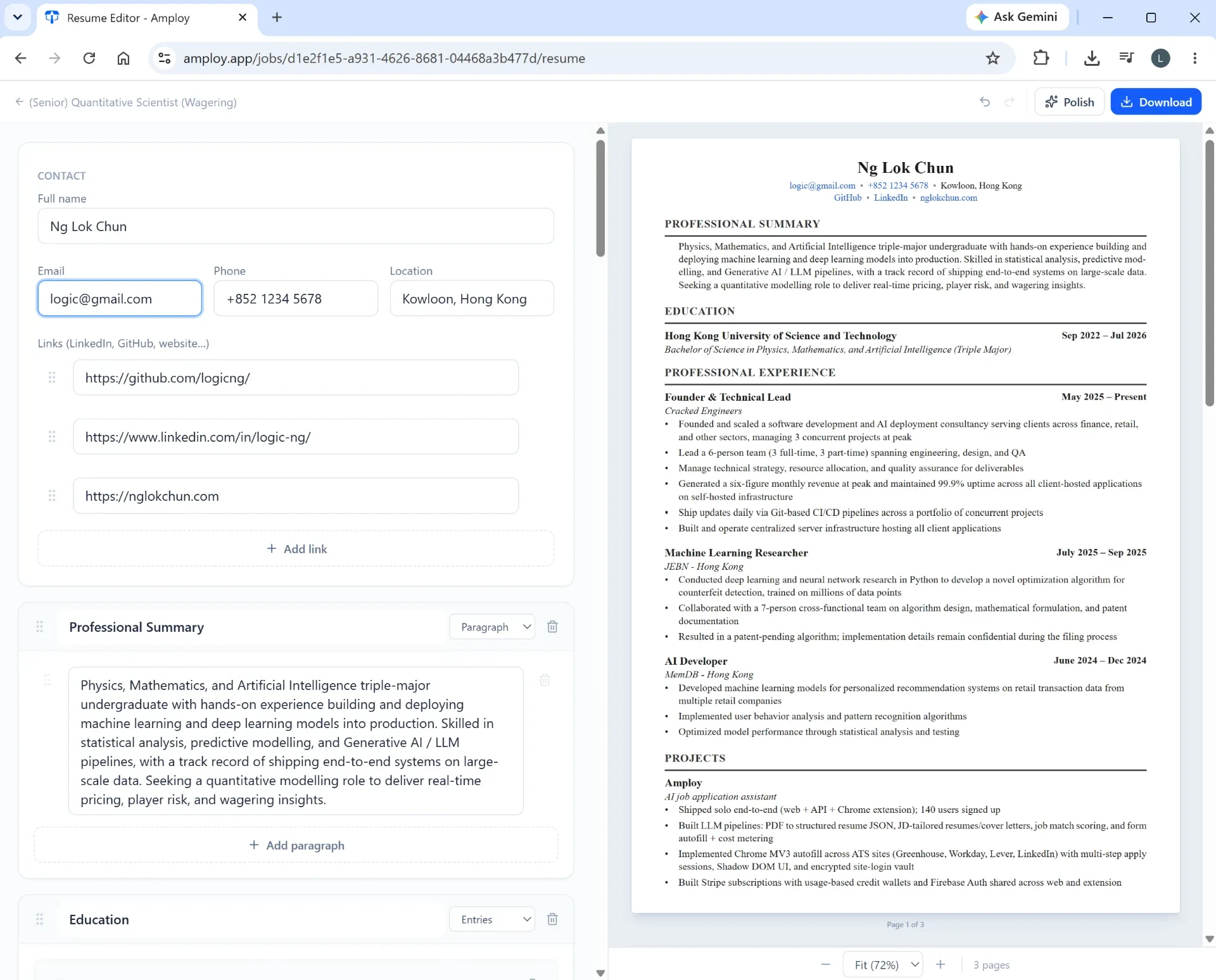
From there, you can tailor a matching resume, track every application through a Saved → Applied → Interview → Offer pipeline, and keep your logins for each company's portal in one place.
The format above will serve you for years. Use it, tailor it, and spend your energy where it actually counts: the specific words that show you've done your homework.