
Cover Letter Examples That Don't Sound AI-generated
Hiring is broken. Most roles get hundreds of applicants, and the people who land interviews are usually the ones who apply more, faster. The cover letter is where a lot of candidates stall out — not because they don't have the experience, but because staring at a blank page is slow and demoralizing.
Here's the thing worth noticing up front: what makes a cover letter sound "AI-generated" isn't the fact that a tool helped you write it. It's the absence of specifics. Generic openings, vague claims, and paragraphs that could describe anyone. Fix that, and nobody reading it will care how the first draft got onto the page.
What actually makes a cover letter sound like a machine wrote it
AI-sounding cover letters share a few fingerprints:
- Vague praise of the company that could be pasted onto any employer.
- Buzzword stacking — "passionate," "dynamic," "results-driven" — with nothing concrete behind the words.
- No numbers, no names, no details about what you actually did.
- Overly smooth, uniform sentences with no personality or specificity.
The fix is never "write less like a robot." It's "put more of you in it." That means real experience, real outcomes, and details a template couldn't guess.
Example 1: The career-switcher opening
Too generic: "I am writing to express my strong interest in the [Role] position at [Company]. I believe my skills align well with your requirements."
Better: "I spent four years running operations for a small retail chain, which meant owning inventory systems, supplier negotiations, and a team of six. I'm moving into product management because the part of that job I loved most was figuring out why customers behaved the way they did — and then rebuilding the process around it."
The second version sounds human because it explains a reason, not just a desire. It connects two things that don't obviously connect, and it names what you actually did.
Example 2: The body paragraph with specifics
Generic AI drafts love to say you're "proven" and "strategic." Real ones show it.
Too generic: "I am a proven leader with a track record of delivering results in fast-paced environments."
Better: "When our support team was drowning in tickets after a product launch, I rebuilt the triage queue and wrote the response templates my team used. Response time dropped, and we stopped losing the newer reps to burnout. I'd bring that same approach — find the bottleneck, fix it, document it so it sticks — to this role."
Notice what's doing the work: a situation, an action, and a result. No adjectives required.
Example 3: The closing that doesn't grovel
Too generic: "I would welcome the opportunity to discuss my qualifications further and am confident I would be a valuable addition to your team."
Better: "I'd like to talk about the redesign you shipped last quarter — I have a few thoughts on where my background in onboarding could help. I'm happy to share a short sample of how I'd approach it in the first 30 days."
A close that gives the reader something concrete — a question, a sample, a specific piece of their work you engaged with — reads as a real person writing to another real person.
The one rule that fixes almost everything
Read your letter back and ask: could this paragraph have been written for any other company, or by any other applicant? If yes, it's filler. Cut it or replace it with a detail only you could supply — a project you owned, a metric you moved, a specific reason you're applying here.
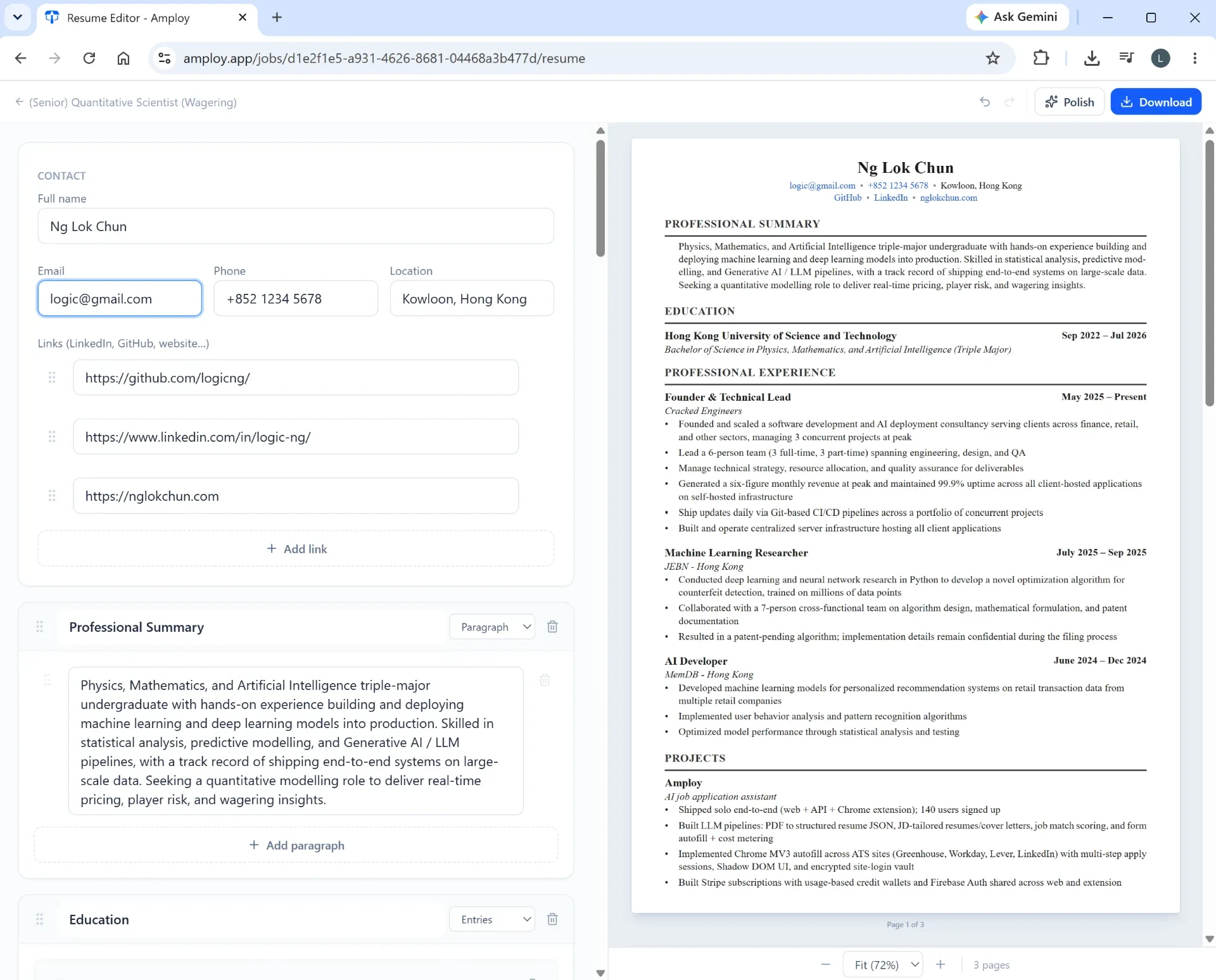
That's also why the human edit matters so much. A tool can give you a fast, structured first draft that references the role and your experience. You still need to edit it into your voice, swap in the real numbers, and replace anything that reads like it was written for the average applicant.
Why this matters more than the quality of any single letter
Applying to more roles is how people land interviews — rejections from a high-volume search aren't personal, they're arithmetic. The trap is that trying to write a bespoke, perfect letter for every application means you apply to fewer of them and burn out on the ones you do.
So the goal is a letter that's genuinely specific and still fast to produce. A draft that starts from your real history and the actual job description gets you most of the way there; a couple of minutes of editing — adding the metric, cutting the buzzword, sharpening the reason — is what turns it into something that doesn't sound AI-generated.
A quick checklist before you hit send
- Does the opening name a specific reason you're applying here, not just "strong interest"?
- Is there at least one concrete detail — a project, a number, a result?
- Have you cut every adjective that isn't earning its place?
- Does the closing offer something real (a sample, a topic to discuss) instead of asking for a favor?
- Would you recognize yourself in it?
If you can answer yes to all five, it won't read like a machine. And that's the whole point: stop wasting so much time on letters that blend into the pile, and spend your time on the volume and the specifics that actually move you forward.