
AI-Based Job Search: What It Actually Automates (and What It Doesn't)
Most "AI job search" tools make the same promise: do less, apply more. But when you actually sign up, it's hard to tell what the AI is doing versus what you're still stuck doing by hand. Below is an honest breakdown of what AI genuinely automates in a job search today, and where you still need to put in the work.
What AI automates well
These are the repetitive, low-judgment tasks where a tool can save real time.
Filling out application forms. Names, phone numbers, work history, education, essay boxes — the same information typed into dozens of different fields on dozens of different career sites. An autofill tool handles this in one click from a stored profile.
Drafting cover letters. AI can generate a first draft that references the specific role and pulls from your real experience. You're not starting from a blank page — you're editing something that already exists. For most applicants, that changes the task from "write" to "review," which is far faster.
Tailoring resume language. The same experience can be framed differently for different roles. AI can rewrite your existing bullets to mirror the language of a job description without inventing experience you don't have — the work is real, the phrasing just gets matched.
Exact match checks. AI is good at comparing lists. A job board that scores your skills and experience against a posting gives you a fast read on whether the role is worth applying to at all.
Repetitive tracking. A status pipeline that moves each application through Saved → Applied → Interview → Offer, alongside the tailored resume and cover letter for that role, keeps a high-volume search from becoming a spreadsheet mess.
Where AI still can't help
Be skeptical of tools that claim to handle the entire search.
Deciding what you actually want. AI can't tell you whether a role fits your goals, your values, or what you're willing to relocate for. That's the one part of the search that stays entirely yours.
The final judgment on a tailored resume. A rewrite can drift from your actual experience or overstate a skill. Every AI-generated resume and letter needs a human read before it gets submitted. Autofill is fast; you're still the editor.
Outreach and relationship-building. A referral from someone who knows your work still outperforms a cold application. AI doesn't change that, and it shouldn't pretend to.
Managing a high-volume pipeline. If you're applying to dozens of roles, tracking which resume and letter went where is a genuine admin burden. Tools help here, but the discipline of actually using the tracker is on you.
Logging into career sites. Some of the friction in a search is pure account management — the same employer site, the same portal, a password you set eight months ago and never wrote down. It's not glamorous, but it's real, and it's the kind of thing a password saver handles so you're not locked out of a site you applied on last week.
Why the busywork matters in the first place
Hiring is broken. Most roles receive hundreds of applicants, and the honest way to read a rejection is usually that the role got flooded — not that you weren't good enough. The candidates who land interviews tend to be the ones who apply more, and faster, across more roles.
That's the logic behind an AI-based job search: not to make your application better than everyone else's, but to make it easier to send a good one to more places without burning out. AI is best deployed against the repetitive parts — form-filling, drafting, tailoring, drafting again — so your energy goes to the decisions and the relationships.
How Amploy fits in
Amploy is built specifically for that division of labor. The Chrome extension and website automate the repetitive tasks — one-click autofill from your profile, cover letter drafts that reference the role and your real experience, resume rewrites matched to each job description, a job tracker that keeps every tailored resume and letter next to its application status, and a password saver so you're not locked out of a career site mid-application.
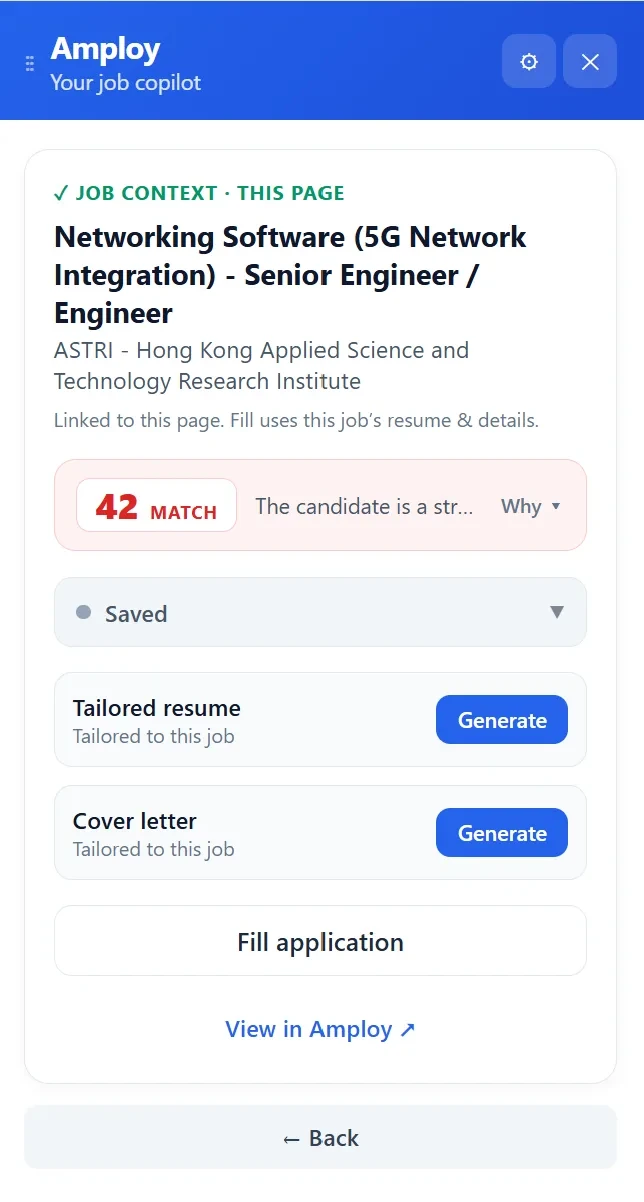
The parts that stay yours: deciding what to apply to, reading the tailored resume before you hit submit, and doing the human work of building relationships and showing up for interviews.
A practical way to start
- Build your profile once. Everything Amploy's autofill and generation tools pull from starts there.
- Use the match check as a filter. Let the score tell you which roles are worth the tailoring time — not which ones to apply to.
- Generate, then edit. Treat every cover letter and resume rewrite as a draft in your voice, not a finished product.
- Track as you go. Add each application to the pipeline and keep the tailored materials attached to it.
- Save your logins. The same career sites will show up repeatedly. Don't lose time resetting passwords.
AI does the parts of the search you don't want to do. You keep the parts only you can do. That's the version of an AI-based job search worth using.